Anthropic is Winning - What Signals to Look for Broader Market Impact
Key Anthropic metrics to monitor for broader impact to hyperscalars & AI infrastructure buildout stocks.

In Q1 2026, Google’s Gemini grew token production roughly 60% quarter-on-quarter - from 10 billion to 16 billion tokens per minute.
By any normal software benchmark, that is a strong quarter. By the standard that actually matters in frontier AI, it was a miss.
Anthropic grew approximately 15x in the same period.
That gap - not valuation, not benchmark scores, not funding rounds - is the real signal in the AI race right now. Millions of developers had access to both products and made a choice. They chose Claude.
Why Benchmarks Don’t Win Markets
Rory O’Driscoll said it plainly: Gemini is “nearly as good” on evals but has not been able to get traction where it matters - coding. Rory O’Driscoll, 20VC The implication is counterintuitive.
If two products score similarly on capability tests, you would expect market share to be roughly proportional. It is not.
The reason is that developer adoption does not follow a linear adoption curve. Coding assistants create habits. They embed in workflows - editors, CI pipelines, review loops. Once a developer has built muscle memory with one tool, the switching cost is not the evaluation time. It is the friction of re-learning an interface that already works. And Anthropic built that habit at a moment when developers had given up on OpenAI after a difficult stretch.
The benchmark is a door opener. The habit is a lock.
Google has the infrastructure, the capital, and the data. It has not closed the adoption gap despite near-parity performance. The gap between eval scores and market share is the most underappreciated dynamic in the AI race.
The Compute Reality
Anthropic’s CFO, Krishna Rao, describes compute procurement as “the lifeblood of our business” and “the most important thing in the company.” Krishna Rao, Invest Like The Best
He does not mean this as a figure of speech. Anthropic holds daily meetings to allocate compute across use cases.
Not quarterly. Not weekly. Daily.
The decisions made in those meetings determine which customers get served, which research advances, and how fast new model generations ship.
This is not a symptom of poor planning. It is the structural reality of operating at the frontier. Anjney Midha - Anthropic’s founding investor - put it without hedging: “If there’s any reason why OpenAI, Anthropic, Gemini don’t hit their revenue targets over the next few years, it’s because they won’t have access to enough compute.” Anjney Midha, 20VC
Compute is a supply-side constraint, not a demand-side one. Anthropic’s growth is limited not by what customers want but by what Nvidia can deliver. That dependency runs through CUDA - the software layer that creates switching costs so high that even GPU hardware parity (AMD) cannot break the lock.
Anthropic’s 15x token growth directly translates to Nvidia demand. Anthropic has no path to escape that.
The company’s answer to the constraint is inference efficiency. Architectural improvements across Claude generations reduce the compute required per output. At Anthropic’s scale, a 10% efficiency improvement across millions of daily inference requests is not incremental - it is the difference between serving the next tranche of customers or turning them away. The compounding matters more than the percentage.
What the Valuation Repricing Actually Reflects
In a year, Anthropic’s valuation went from $9 billion to $45 billion. It has since reportedly raised $50 billion at a $900 billion valuation. Harry Stebbings, 20VC These are private market numbers - take them as signals, not data.
What changed in a year was not the product. What changed was visibility. The 15x token growth made explicit what was previously faith-based: developers are choosing Claude at a rate that compounds. Rory O’Driscoll’s team at Scale Venture Partners is now actively surveying portfolio companies on token intensity - how much are they spending on which models - because the revenue mechanism is becoming clearer.
Rory’s capex math is worth understanding: Anthropic’s compute commitments run at approximately 3-4x current revenue. When revenue is growing 10x per year, the company is committing $30 billion in capex for every $1 billion in current revenue. Rory O’Driscoll, 20VC There is no such thing as too much capital in this structure. The $50 billion raise is not a vanity round. It is the only financially rational choice available.
The Development That Changes the Near-Term Calculus
xAI leased the Colossus H100 cluster to Anthropic: 220,000-plus Nvidia GPUs and 300 megawatts of power. All four hosts on the May 8 All-In episode treated this as the most significant enabling event for Anthropic this year. Claude’s rate limits doubled immediately after the deal closed. API caps for paid users were removed. Jason Calacanis, All-In Podcast
David Sacks’s reaction was direct: “The only thing holding them back in the future was compute. Now they’ve made this deal. I think it’s pretty much a foregone conclusion that they will hit that forecast of 10x this year, exiting the year.” David Sacks, All-In Podcast His base case - Anthropic exits 2026 at $100 billion in ARR - is now framed as near-certainty conditional on compute availability rather than a bull-case scenario.
The irony of the deal is hard to miss. Anthropic addressed its compute constraint by leasing infrastructure from the company whose founder is simultaneously suing OpenAI in federal court and whose Grok model competes directly with Claude. The dependency on Elon’s infrastructure adds a new dimension of counterparty risk that did not exist before. For now, both sides have aligned incentives: Anthropic gets GPUs, xAI converts stranded capex into cash-generating hyperscaler revenue. But aligned incentives today are not a permanent condition.
The Risk That the Market Is Underpricing
The Colossus deal reduces the immediate constraint. It does not eliminate the competitive dynamics that compute scarcity was already influencing.
OpenAI has responded. GPT 5.5 - built on a new base model receiving strong reviews from Silicon Valley developers - is shifting momentum. Codex is gaining share in coding tokens. Two weeks before the All-In conversation on this, Anthropic appeared to be running away with the developer market at 10x growth versus OpenAI’s 3x. That gap is narrowing. David Sacks, All-In Podcast
And Anthropic handed OpenAI some of that momentum before the deal closed. Opus 4.7’s compute gating - reducing thinking time to manage scarce GPU resources - degraded output quality visibly enough that many developers rolled back to Claude 4.6.
The compute constraint is not an external risk. It is the internal policy choice that can unravel a lead built on developer habit.
The Unresolved Question
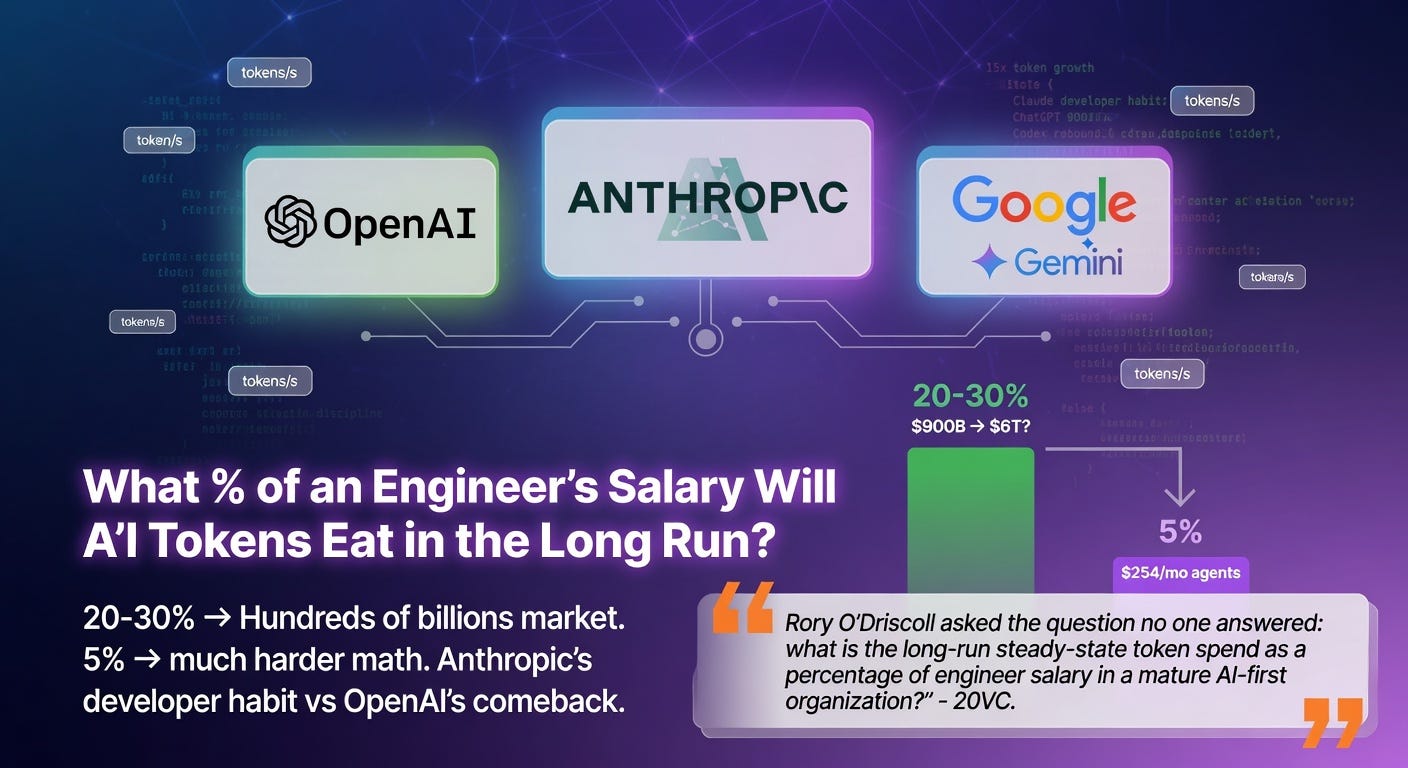
Rory O’Driscoll asked the question that no one answered: what is the long-run steady-state token spend as a percentage of engineer salary in a mature AI-first organization? Rory O’Driscoll, 20VC
If the answer is 20-30% of a $200,000 engineer’s salary, the revenue market scales to hundreds of billions and Anthropic’s $900 billion valuation requires only modest assumptions.
If the answer is closer to 5% - as Jason Lemkin’s $254/month enterprise AI VP agents suggest is possible - the math becomes much harder to reach those valuations.
Anthropic owns the developer market right now. The 15x token growth is real. The efficiency gains are real. The operational discipline around compute allocation is real.
What is not settled is whether a habit is a moat.
OpenAI built the consumer habit with ChatGPT’s 900 million weekly users. Anthropic built the developer habit with Claude. Consumer habits proved stickier than people expected. Developer habits may prove stickier still - or OpenAI’s rebound with Codex may demonstrate that the developer market, like the consumer market, returns to the incumbent when the incumbent competes.
The answer determines whether Anthropic is on its way to $6 trillion or whether the $900 billion valuation is the peak of a very good year.
Alpha Takeaway
Anthropic’s 15x token expansion in Q1 2026 translated directly into accelerated GPU procurement.
If that rate holds above 8-10x into Q3, Nvidia’s datacenter revenue forecasts look conservative.
If it decelerates to 3-5x - either because OpenAI closes the developer gap or because a compute gating event like Opus 4.7 hands back market share - the demand signal that justified H100 and Blackwell order books weakens faster than sell-side models will update.
Inference cost compression is the signal most investors are sleeping on.
Anthropic’s efficiency gains across Claude generations reduce compute per output. At the current scale, aggressive cost-per-token improvement means the same revenue growth requires less GPU procurement - which is bearish for semiconductor demand at the margin even as revenue compounds.
Watch how Anthropic talks about model efficiency relative to capacity expansion. If efficiency is outrunning capacity adds, the hardware demand curve is flatter than the ARR curve implies.