Podcast Alpha Emerging Trends | Software Rewrite Supercycle: Introduction
A clear trend is emerging in SaaS companies. Podcast Alpha is analyzing each discussions in depth to detect and act on this trend and help you to stay ahead of the market.

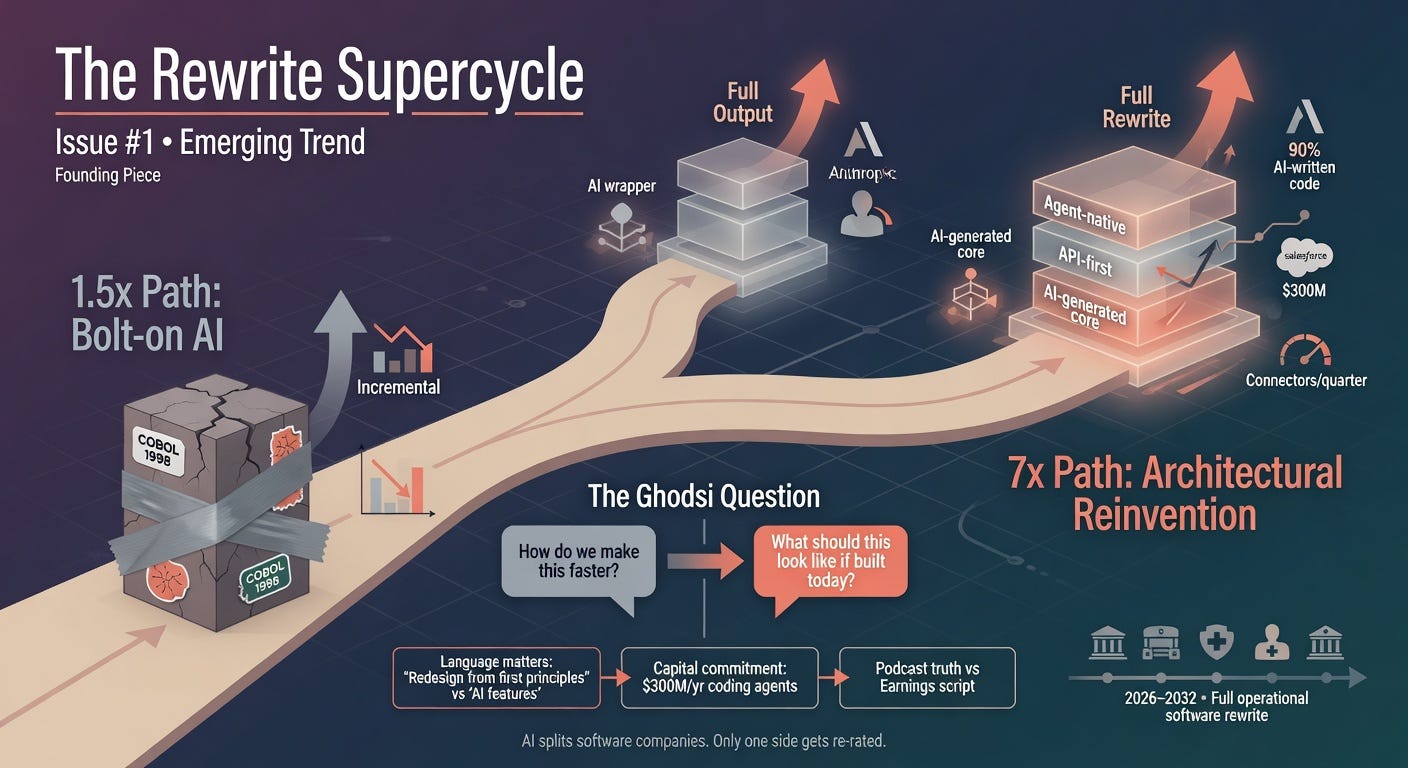
This series tracks new signals on one thesis: the software rewrite cycle creates concentrated demand for AI-first solutions & workforce, not displacement. Each issue surfaces fresh evidence from the podcasts we analyze to find investment opportunities. Future issues of this series will be for paid subscribers.
Software stocks are at 15-year valuation lows. The market has priced AI as a disruption threat to software incumbents. That read is half right.
AI does not disrupt software companies uniformly. It splits them. Some will execute a fundamental architectural reinvention and re-rate significantly. Others will bolt AI features onto legacy architecture, generate short-term cost savings, and get displaced by companies that rebuilt from scratch. The spread between those two categories, over the next decade, is one of the most significant investment opportunities in technology.
This series tracks the signals that tell you which companies are which - before they reach analyst coverage.
The Scale of What Is Coming
In April 2026, Chamath Palihapitiya and David Friedberg, All-In arrived independently at the same prediction: all operational software running the world gets rewritten within 5-6 years. Two forces converge. AI-powered vulnerability discovery exposes the fundamental insecurity of all human-written legacy code. And AI coding tools reduce the cost of replacement enough to make it economically viable for the first time.
The scale is not marginal. Operational software - banking, logistics, healthcare, insurance, government - has been accreting modifications for decades. Replacing it represents one of the largest software procurement cycles in history.
The transition is already running at the frontier. In May 2026, Dario Amodei disclosed that 90% of Anthropic’s own code is now written by AI. GitHub’s agentic PR benchmark moved from 5% to 77% in eighteen months. Marc Benioff is spending $300 million per year on Anthropic coding agents. That is not projected demand. That is a current budget line at one company.
The question for investors is not whether the rewrite happens. It is which companies sit on the right side of it.
The Signal That Separates Winners from Laggards
The most useful analytical framework for investors comes from Ali Ghodsi, CEO of Databricks, speaking at Stanford in May 2026 with visibility into approximately 20,000 enterprise customers.
Ghodsi, MS&E 435 handed two engineers the same problem: compress a nine-month connector development cycle using AI tools. Both had access to the same models. Engineer one returned with seven and a half months of improvement. Engineer two returned with seven connectors per quarter.
The difference was not the tools. It was the question each asked. Engineer one asked: how do I make this process faster? Engineer two asked: what should this process look like if we designed it today from scratch?
Ghodsi’s conclusion: “GPT-7 would not have helped.” The constraint was organizational, not computational.
This is the investor framework.
Two companies can both announce AI adoption. One delivers a 1.5x improvement on existing workflows. The other redesigns from first principles and delivers 7x. They look identical in a press release. They look very different in three years.
The 7x outcome requires a specific organizational decision - one that is visible in how companies talk about their AI transition long before it shows up in P&L.
Why the Displacement Narrative Is Distorting the Trade
The conventional framing - AI disrupts software, headcount falls, companies get leaner - is pushing investors toward the wrong read on which names are attractive.
Dan Ives of Wedbush argued in May 2026 that Dario Amodei is “100% wrong” on AI job displacement. Ives, Anthony Pompliano Podcast: as models commoditize and hundreds of LLMs proliferate globally, the differentiator shifts from model quality to people. Engineering talent, product design, execution. His supporting data: 80% of AI-attributed layoff announcements are pandemic over-hiring corrections that found AI as convenient narrative cover.
The companies executing the rewrite correctly are not shrinking their engineering organizations. They are changing which engineers they need.
The distinction matters for valuation. Cost-cutting AI stories and architectural reinvention stories deserve different multiples. Right now most investors are pricing them the same.
The Architectural Obsolescence Pressure
Two forces are converging on every software incumbent simultaneously, and neither is optional.
Brian Chesky made a structural claim about software in May 2026. Chesky, Invest Like the Best: agents replace apps.
The codebase that exists today is not just aging. It is architecturally incompatible with where computing is going.
Legacy enterprise software was built for a world where users retrieve information through interfaces. Agents do not use interfaces. They call APIs directly, execute tasks, make decisions. Software built for the retrieval era does not upgrade into the agent era.
Jensen Huang supplied the hardware layer version in May 2026: “The computing model was stable for 64 years. Now everything is generated, not retrieved.” That shift changes hardware, software model, and application surface simultaneously.
This is not cycle risk for software companies. It is replacement risk. The companies that execute the reinvention capture the cycle. The ones that do not face displacement from companies that did - regardless of their current market position.
What to Watch: Early Signals Before the Re-Rating
The signals that precede the valuation re-rating are organizational, not financial. They appear in podcast conversations and long-form interviews before earnings calls:
Architectural redesign language versus feature-level AI announcements. Companies announcing new AI features are doing the 1.5x work. Companies announcing process redesigns from first principles are doing the 7x work. The difference is in how they describe the organizational change, not the technology.
AI coding spend as a commitment signal. Benioff’s $300 million on external coding agents signals that Salesforce is treating the rewrite as a serious capital allocation priority. Companies that have not made this kind of commitment are still in announcement mode.
What CEOs say in long-form interviews versus earnings calls. Podcast conversations reveal actual organizational thinking. Earnings calls reveal what management wants the market to hear. The gap between the two is where early signals live - and where this series operates.
Valuation entry context. Software stocks are at 15-year valuation lows, per Tom Lee, Meb Faber Show. The market has not yet differentiated between executors and laggards. That differentiation is where the alpha sits.
If You Are Positioned
You are evaluating software names at 15-year valuation lows. The evaluation framework shifts from “does this company use AI?” to “is this company redesigning from first principles or layering AI onto existing architecture?” Watch for CEO language in long-form formats that reveals organizational intent - that signal precedes the financial data by 18 to 24 months.
The Decade Ahead Is Not Priced In
The counter-evidence is real. Software rewrites have historically been disastrous. “Never rewrite from scratch” is one of the most repeated lessons in engineering, earned from projects that collapsed mid-execution. None of the forces driving this wave make that problem disappear. They make the rewrite more economically motivated. They do not make it more likely to succeed.
The companies that execute it correctly will be among the most significant wealth creators in technology over the next decade. The ones that do not will be replaced by companies that did - regardless of their current size, installed base, or market position.
That spread is not in the data yet. It shows up in organizational decisions first. Podcast conversations, hiring patterns, how CEOs describe the work when no one is building an earnings model around their words.
That is what this series tracks.
Each issue surfaces new evidence from the podcasts we analyze on which companies are executing the architectural reinvention and which are not.
Paid subscribers will get each signal as it emerges.
The content on Podcast Alpha is for informational and educational purposes only and does not constitute financial, investment, or legal advice. Investing in stocks, bonds, or other assets carries a high level of risk, and you may lose some or all of your capital.
Always conduct your own research and consult with a certified financial professional or fiduciary before making any investment decisions. Podcast Alpha and its authors are not registered financial advisors, brokers, or dealers. By reading this blog, you agree that Podcast Alpha is not responsible for your financial success or failure.